

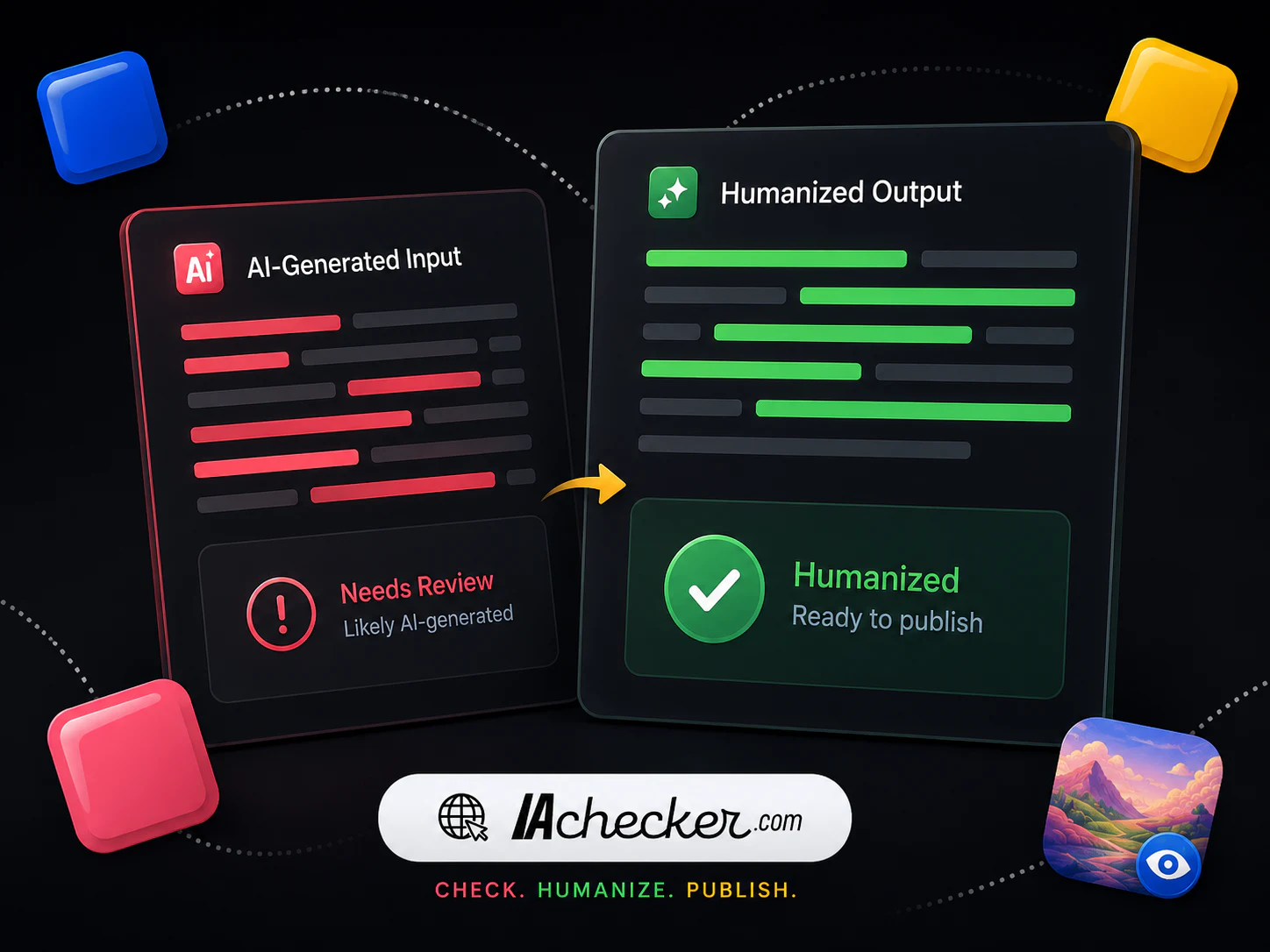
One connected workflow
Detection is one step ina longer workflow.
Check a draft, then rewrite it or review the media beside it.
How this detector works
Detect everything
Pasted text, PDF, Word, Google Docs and more. One multi-tool workspace for every document format you check.



What a detection report actually shows
A score alone is not a report. This mixed sample shows the verdict, the sources, and where they sit in the text.
Example report · Concorde1
Navigate bySimilarities
AI18%
Plagiarism27%
Concorde1

Image from ChatGPT
Introduction
The Concorde is a retired turbojet-powered supersonic airliner developed jointly by Britain and France. First flight was in 1969, and scheduled passenger service began in 1976 with Air France and British Airways. Only twenty airframes were built, including the prototypes, which is why the type never became a mass-market jet. This essay asks how a machine that looked like the future stayed confined to a handful of routes, then left the sky in a single decade.
It is one of only two supersonic transports to have been operated commercially. The other is the Soviet-built Tupolev Tu-144, which entered service earlier but flew far fewer passenger routes. Concorde was jointly developed and manufactured by Sud Aviation and the British Aircraft Corporation under an Anglo-French treaty. Scheduled flights began on 21 January 1976 on the London to Bahrain and Paris to Rio de Janeiro routes, with transatlantic services to Washington and New York following once noise and landing rights were settled.
I. A machine built for a handful of routes
Promotional pictures still circulate of the aircraft over cities it never served at low altitude. A generated view of the delta wing above the Colosseum in Rome is a typical example: striking, and historically impossible. Those images now sit next to encyclopedia copy in student papers and travel blogs.
A typical London to New York crossing took under three and a half hours, less than half the time of a subsonic jet. Cabins stayed small, tickets stayed expensive, and the sonic boom kept most overland routes off the map.
II. Speed, cost, and the sonic boom
It cruised at about twice the speed of sound. High operating costs and a short route list kept the fleet small, and the last commercial flight was in 2003. After the Paris crash in 2000 and a drop in long-haul demand, both airlines retired the type within three years. Fuel, spare parts, and a cabin of about a hundred seats made every empty row expensive.
Conclusion
The airframe is still the reference for later supersonic passenger projects, from Boom to the research aircraft that try to quiet the boom. What the Concorde proved is narrower than the myth — speed can be sold, but only on a few corridors, and only while the economics hold. Once they did not, the future folded back into museums and generated pictures of a jet that never flew over Rome.
Our published detection record
Most detectors market an accuracy figure and never publish the false-positive rate, which is the number that actually matters when a person is being accused. Here is our latest run in full, on a 20-text regression corpus scored by Advanced 3.2. It is sized to catch a break between model versions rather than to settle a global accuracy claim, and we would rather return an uncertain verdict than a false accusation.
- Human texts that stayed classified human
- 10 of 10
- AI texts classified AI
- 5 of 10
- AI texts that landed in a hybrid tier
- 5 of 10
- Human and AI inversions
- 0
Checked against more than one engine
One engine is one opinion. A detector that only ever agrees with itself gives you no way to tell a confident result from a lucky one, so a report can put our verdict side by side with other detectors on the same text and show you where they disagree.
- Originality.aiIntegrated
Runs on the same text as your IA Checker result, so a disagreement between the two is visible instead of hidden.
- ZeroGPTIntegrated
A widely used free detector. Seeing it agree, or not, is often the fastest way to judge how much weight a score deserves.
- Pangram 4Integrated
A specialist detection engine available as a third opinion inside the suite. It is not counted in the corpus run above, which was scored by Advanced 3.2 alone.


The signals behind a score
Every report shows the same three measured signals, each scored from 0 for human-leaning to 100 for AI-leaning. They are reported separately on purpose. A single high signal is a weaker case than three that agree, and you can see which one is carrying the verdict.
- Rhythm uniformitySentence cadence variance
Human drafts vary sentence length in bursts: a long clause, then a short one, then a fragment. Generated prose tends to settle into a narrow band. A high score means the cadence is unusually even, which is common in AI output and also in heavily copy-edited text.
- Punctuation flatnessPunctuation range
The engine looks at how many punctuation devices the writing actually uses: semicolons, parentheses, dashes, question marks. A narrow range scores high. Note that formal registers legitimately flatten punctuation, which is why this signal rarely decides a verdict alone.
- Formulaic phrasingPatterns & structure
This aggregates connector vocabulary, document structure and contextual grounding: whether the text names specifics or stays at a level of generality that any model could produce. It is usually the most informative of the three, and the hardest to fake in either direction.
Reading the verdict
The result is not a percentage with a pass mark. It lands on one of nine tiers, and three of them sit deliberately in the middle because that is where a lot of real writing belongs.
- Human-writtenSignals agree, strongly, on human authorship.
- Almost certainly humanSignals lean human with one minor counter-signal.
- Most likely humanHuman-leaning, but the sample is not decisive.
- Humanized AIPatterns consistent with generated text that has been rewritten to read more naturally.
- Part human, part AISegments diverge: some passages read generated, others do not.
- Too close to callThe measured signals are split. The honest answer is that we do not know.
- Most likely AIAI-leaning, but short of a confident call.
- Almost certainly AISeveral independent patterns are compatible with generated writing.
- AI-generatedSignals agree, strongly, on generated authorship.
The three middle tiers are the point of the scale. A detector that only answers human or AI has to force every ambiguous sample into one of them, and ambiguous samples are the ones where a wrong answer costs somebody their grade or their job application.
What you can run through it
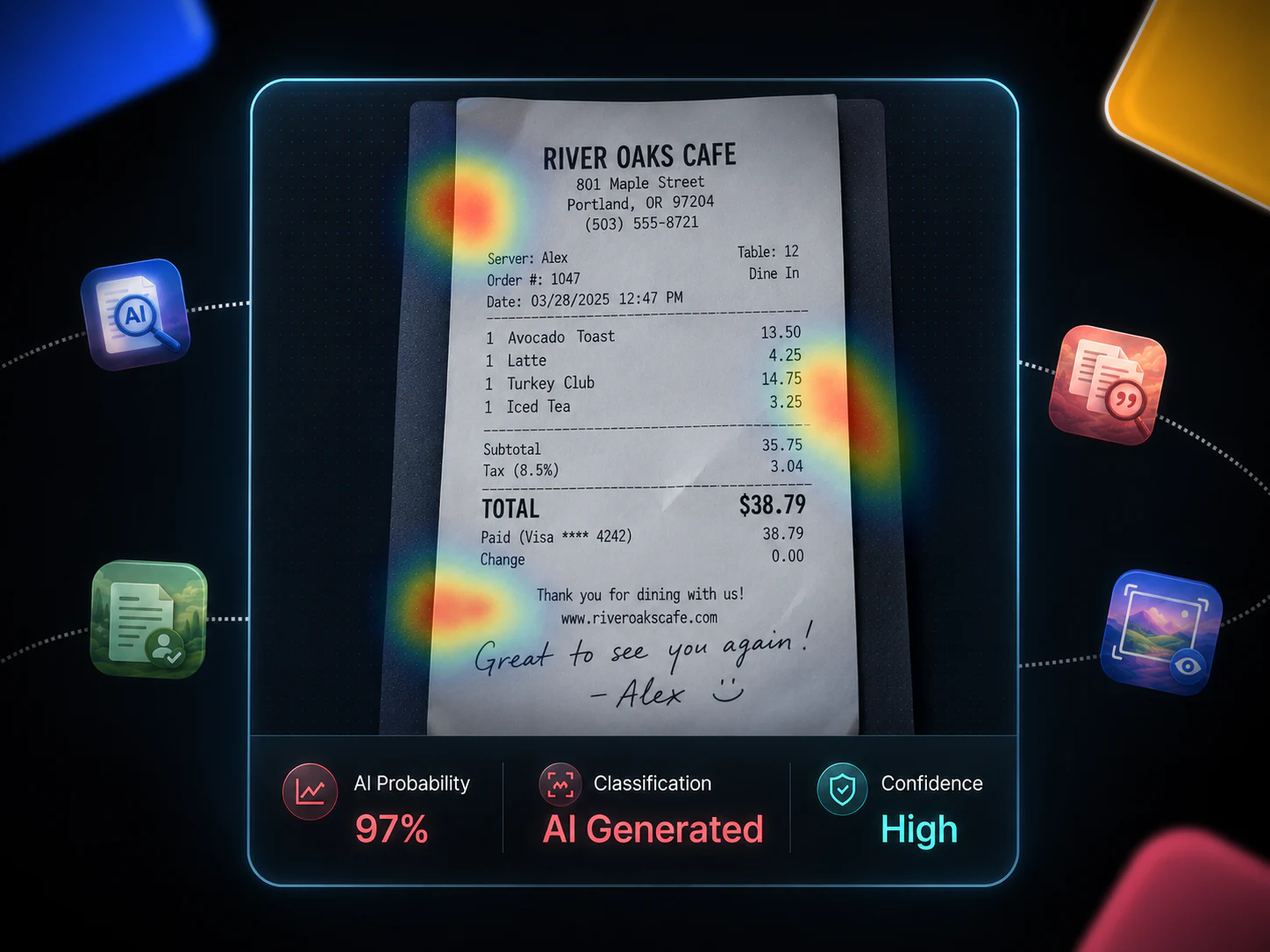
Paste text directly, give the checker a URL to scan, or upload a file up to 20 MB. PDF, DOCX, TXT, Markdown and CSV are read natively. Images and scanned pages go through OCR first, so a photographed page or a screenshot of a document can be checked as well.
Longer samples produce better evidence. Under roughly a paragraph the engine flags the result as uncalibrated, because style signals on a few sentences are close to noise. If you only have a short extract, treat the output as a prompt to look closer rather than as a finding.
Which model runs your check
Advanced 3.2 runs free checks and is the model behind the published record above. Ultra 3.2 is on paid plans, with the same signals and a wider feature set. Pangram is available as a second opinion.
Signal names and the verdict scale stay the same across models, so results stay comparable.
Using a result responsibly
A score shows how much a text resembles generated writing. Open the sentence-level view to see which passages carry the signal.
If you need to discuss a result, drafts and version history are the useful record. The sentence-level breakdown shows which passages triggered which signal.
Good to know
Questions people ask, answered.
Hover a row to stop it, or swipe through on a phone.
How accurate is this AI detector?
On our latest published run, 10 of 10 human texts stayed classified human and 5 of 10 AI texts were classified AI, with the other 5 held in a hybrid tier and no inversions. That corpus is 20 texts, sized as a regression check rather than a global accuracy measure, and we publish it with that limit stated. Treat any detector advertising a single high accuracy percentage without a published corpus with caution.
Can an AI detector prove someone used ChatGPT?
No. A detector measures statistical properties of writing, not authorship. It can tell you that a text has patterns common in generated writing. It cannot establish who produced it, and it should never be the sole basis for an accusation.
Why was my own writing flagged as AI?
The most common causes are writing in a second language, a formal or technical register where formulaic structure is the convention, heavy editing or grammar-tool passes that smooth out sentence variance, and samples too short to carry signal. Open the sentence-level view to see which passages triggered which signal.
Are AI detectors biased against non-native English writers?
Published research has repeatedly found elevated false-positive rates on non-native English writing across commercial detectors. The reason is structural: second-language writing tends toward regular cadence and a narrower vocabulary, which is what style-based detection reads as machine-like. This is a known limit of the method, and it is why a score must not stand alone in an academic integrity procedure.
Can this detect AI slop?
It can rank a batch by how much each text resembles generated writing, which is the useful half of AI slop detection. It cannot score slop itself: whether content is accurate, original or actually reviewed is an editorial judgement, not a statistical property of the words. Use the ordering to decide what to read first, then check the facts and citations yourself.
Does rewriting AI text beat a detector?
Substantially reworking a generated draft will usually move the result toward human, because at that point much of the writing is human. Light paraphrasing often lands in the Humanized AI tier instead, which is a distinct verdict rather than a pass.
Is this AI detector free?
Yes. Checks on the Advanced 3.2 model are free and need no account to start. Ultra and the wider suite, including humanization and the document tools, are on paid plans listed on the pricing page.
Can I check a PDF or a Word document for AI content?
Yes. Upload a PDF, DOCX, TXT, Markdown or CSV file up to 20 MB and it is read before the check runs. Scanned pages and images are put through OCR first, so a photographed document works too.
Is my text stored or used for training?
Submitted text is not used to train models. The privacy page sets out what is retained, for how long and why.
Detect AI with confidence.
Access the most advanced multi-tool AI detection across 16+ tools. Try a plan before you pay and cancel whenever you need.
Free
Essential checks, no charge.
forever
- Free detection checks
- 20,000 characters / check
- AI Detector
- EU Labelizer access
- 1 short document upload
- 3 quick image checks
Plus
The best fit for active writers.
/ month
Billed monthly- 300,000 word credits / month
- 75,000 characters / check
- Advanced Humanization
- All writing tools
- Detection history
Pro
Best valueFor professional content workflows.
/ month
Billed monthly- 1,000,000 word credits / month
- 150,000 characters / check
- 10 media checks / month
- All detection tools
- Upload documents
- Website AI checker
Max
Credit on demandFor teams with large volumes.
/ month
Billed monthlyMonthly credits3M words
- 30 media checks / month
- 8,000 Undetectable AI words / month
- Includes all features from other plans
 PANGRAM
Cancel anytime
Custom plans
Built for business.
Need higher volumes or one plan for your team? Get custom credit limits, centralized billing and a setup shaped around your workflow.
- Custom word-credit volumes
- Team-ready billing
- Maximum Humanization
- Implementation planning