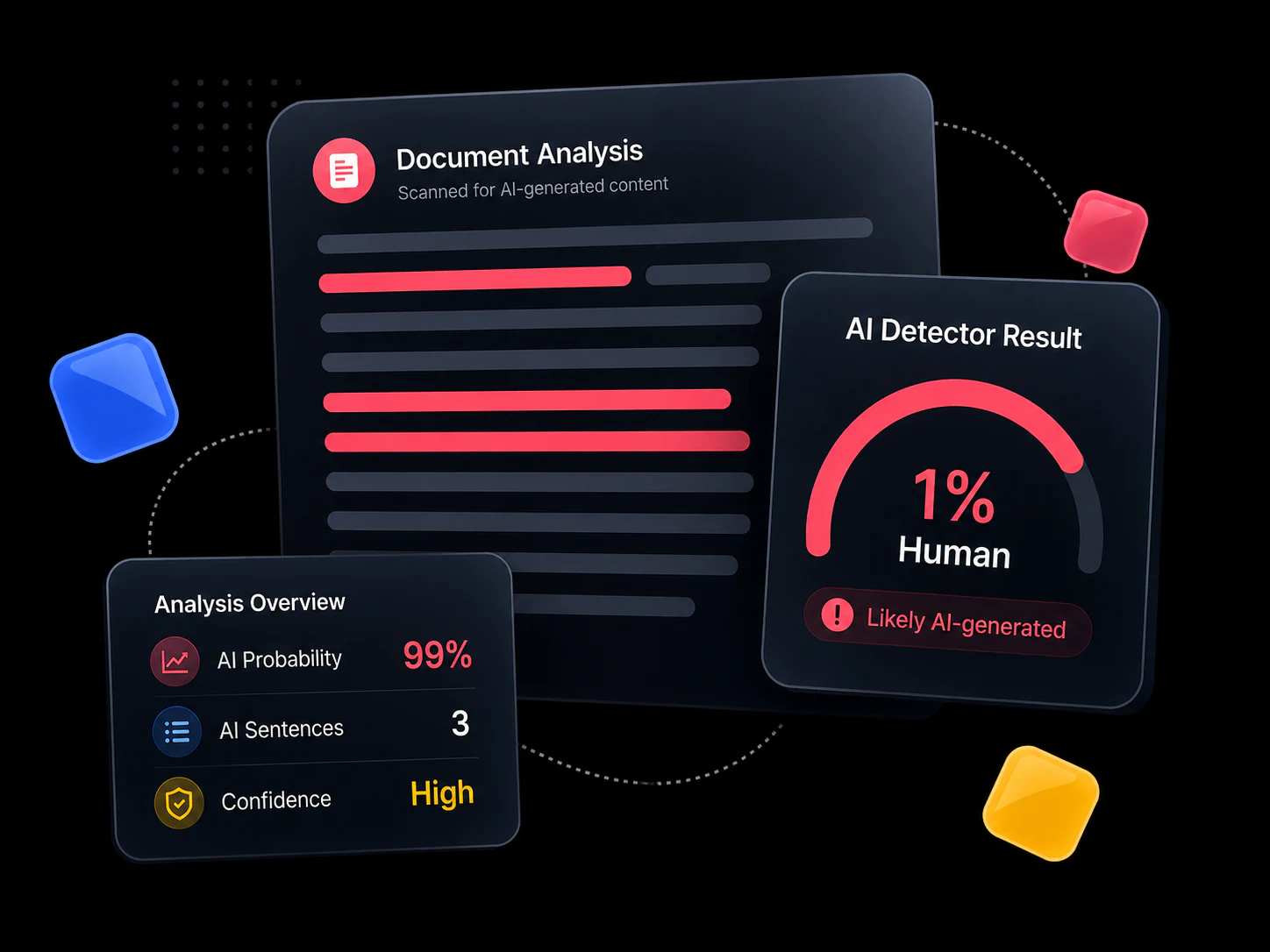
An AI detection score is an estimate of how much a passage resembles writing patterns common in generated text. It is not a verdict on who wrote the document, which model was used, or whether using AI was allowed in that context.
Read the score the way you would read a highlighter: useful for noticing places that deserve a second look, useless as a substitute for reading the work.
What the number is measuring
Most detectors combine stylometric or model-based signals: even cadence, narrow punctuation range, stock transitions, predictable paragraph shape. Different products weight those signals differently, so two tools can disagree on the same paragraph without either being “broken.”
A high AI reading means the text looks like many generated samples the system has seen. A low reading means it looks more like the human side of that training mix. Neither result identifies an author.
Tiers, mixed results and uncertainty
Useful reports do more than print one percentage. They separate strong AI-leaning passages from mixed or human-leaning ones, and they admit uncertainty when the sample is short or the signals conflict.
On IA Checker, the workspace shows a primary reading and sentence-level cues so you can see what drove the result. Hybrid outcomes are normal on edited drafts, collaborative writing and text that started as AI and was rewritten by a person.
If the tool cannot show you which sentences mattered, you are flying blind with a single number.
How much text you need
Short samples are noisy. A paragraph may be enough to raise a suspicion; it is rarely enough to justify a high-stakes decision. Prefer the full section or document, and be cautious when the only available text is a bio, a subject line or a three-sentence cover note.
File uploads help when the source is a PDF or Word document, but extraction quality still matters. Scanned pages and messy layouts can change what the detector actually sees. See how much text you need and the PDF extract tools when the draft is still locked in a file.
Using scores without over-trusting them
- Read the highlighted passages before you act on the score.
- Compare the result to process evidence: drafts, notes, sources.
- Expect disagreement between detectors on edge cases.
- Do not treat a model name in a headline as an attribution result.
- Keep a person accountable for the final decision.
False positives are common enough that schools and hiring teams need an escalation path. Our guide on AI detector false positives covers why human writing gets flagged and what to check next.
Limits you should print next to the score
Detection does not prove ChatGPT use. It does not survive every rewrite. It weakens on non-English text, code-heavy documents and very short samples. IA Checker publishes a small dated regression run on the AI detector page so the limits sit beside the product, not in a footnote you never open.
For the one-sentence version of this article, see what an AI detection score means.