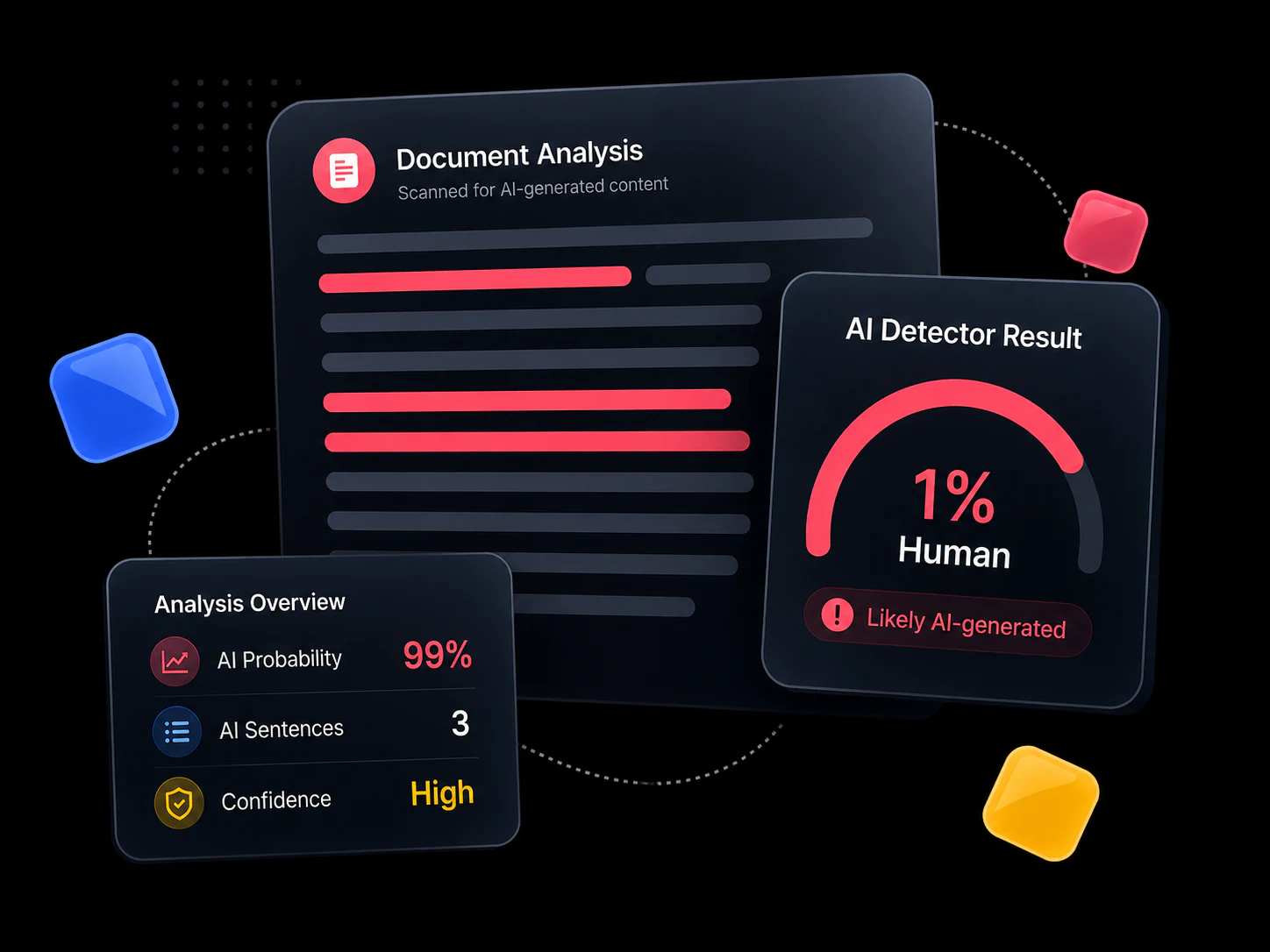
A false positive is human writing labelled as AI. It happens often enough that any serious review process has to plan for it. Detectors estimate how much a passage resembles common generated patterns. They do not see the person who wrote it, the drafts behind it, or the time spent researching.
That distinction matters when a grade, a hiring decision or a reputation sits on the other side of the score. Treat a high AI reading as a reason to look closer, not as proof of misconduct.
What a false positive actually is
In detection, the costly error is calling human text AI. The opposite error, missing generated text, still matters for publishers and platforms. For a student or a job applicant, the false positive is the one that can become an accusation.
Vendors that quote a single “accuracy” percentage without a false-positive rate and a described corpus are selling a headline, not a measurement you can use. Ask for both numbers, on what kind of text, and how short samples were handled.
Why honest writing gets flagged
Several everyday patterns raise AI-like signals without any model involved:
- Short samples. A few sentences give the model almost nothing to compare. Noise dominates.
- Formulaic genres. Cover letters, abstracts, policy blurbs and templated emails already sound uniform.
- Heavy editing. Grammar tools, paraphrase passes and collaborative rewrites flatten rhythm.
- Second-language writing. Careful, regular English can look “too clean” to a detector trained on mixed native prose.
- Technical or translated prose. Domain jargon and translation memory produce repetitive connectors and even sentence length.
None of those prove AI use. They explain why a score can rise on writing that was produced by a person under ordinary constraints.
What to check instead of the percentage
Open the sentence-level evidence when the tool shows it. Ask which passages drove the result. Then ask process questions a score cannot answer: drafts, notes, sources, time spent, earlier versions.
A percentage without passages is a rumour. Passages without context are still only a lead.
If you are the person flagged, ask for the highlighted spans and explain how those sentences were written. Specificity beats arguing with a single number. If you are the reviewer, document what you checked beyond the detector so the decision can stand without the tool.
What detectors cannot tell you
They cannot name the model that wrote a sentence. They cannot prove who sat at the keyboard. They cannot separate “used a chatbot for an outline” from “pasted a finished essay.” Mixed authorship, light AI editing and human polishing of generated drafts all blur the boundary further.
IA Checker keeps that framing visible on purpose. The AI detector returns indicators and sentence-level signals; a person stays in the decision. For classroom and hiring contexts, see the guides for teachers and recruiters.
Practical rules that reduce harm
- Never use a score as the sole basis for a penalty or a rejection.
- Prefer longer passages over snippets when you run a check.
- Read the flagged sentences before you talk to the writer.
- Ask for process evidence when the stakes are high.
- Record what the detector showed and what else you considered.
For a shorter answer to the same problem, see why human text gets flagged and what to do if you were wrongly accused.