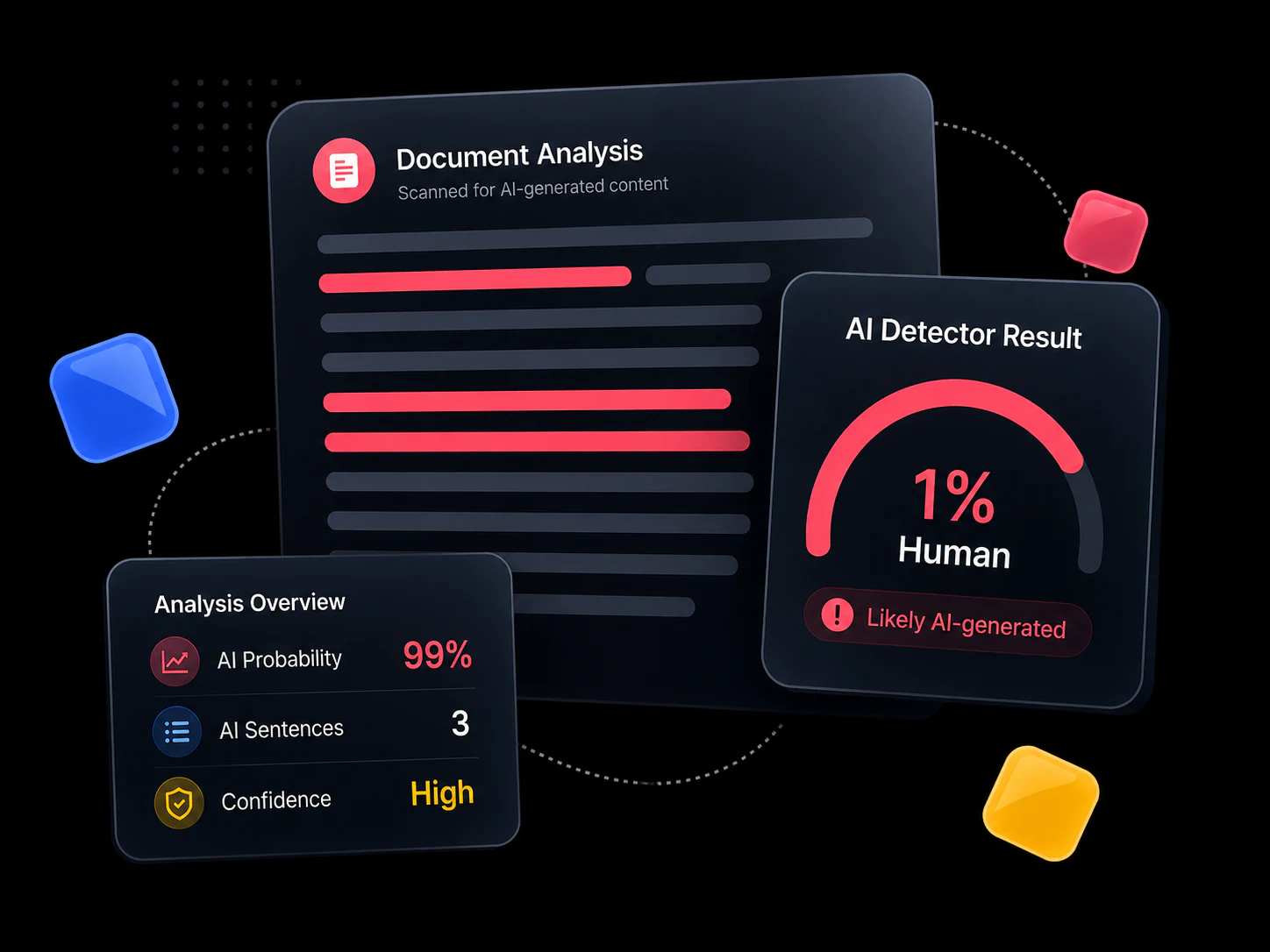
Schools did not invent AI detection to replace teaching. They reached for it because take-home writing became harder to trust overnight. The tool only helps if the process around it stays fair.
This article is for teachers, examiners and academic-integrity staff who need a clear sequence: policy, triage, conversation, documentation. Students who were flagged can start with the student angle.
Policy before tooling
Say whether drafting with AI is banned, restricted or allowed with disclosure. Ambiguity is what turns a detector score into a surprise penalty. Students already know these tools err; credibility comes from showing how your course will use them.
In-person exams with locked devices are a design problem, not a detector problem. Spend energy there when the assessment format allows it. Detectors matter most on take-home essays and portfolios — see the essay angle for format-specific false-positive shapes.
Use scores for triage, not verdicts
Run the detector. Open sentence-level highlights. Decide whether the draft needs a slower human read — not whether the student is guilty. A percentage cutoff wired into a learning platform will quietly harm honest writers.
Hybrid tiers such as “Humanized AI” or “Too close to call” are not synonyms for “cheated.” Write them up as uncertain signals, or do not write them up as findings at all. The teacher angle is the shorter workflow version of this section.
ESL bias and fairness
Published evaluations of commercial detectors have repeatedly shown elevated false-positive rates on second-language writing. A global or multilingual classroom that auto-escalates on score becomes a language test dressed as an integrity test.
Build review time for that bias into your process. Compare flagged work to earlier submissions from the same student. Sudden fluency jumps matter more than any single percentage. Background on why this happens is in why AI detectors flag human writing.
How to talk with students
- Show the highlighted passages, not only the headline score.
- Ask about process: drafts, notes, time spent, sources.
- Ask the student to explain a flagged paragraph in their own words.
- Do not lead with “our AI proved you used ChatGPT.”
- Offer a path to resolution that matches your written policy.
A score is a reason to talk. It is not the talk. Students who need the mirror view can read what to do if wrongly accused.
What to keep on file
If you act on a detection result, keep the extract, the report and your notes. That protects both the student and the institution when the decision is later reviewed. For PDFs, extract text first so you know what the engine actually saw — how to check a PDF for AI.
When you are ready to inspect a draft, use the AI detector and keep a person accountable for the final call.