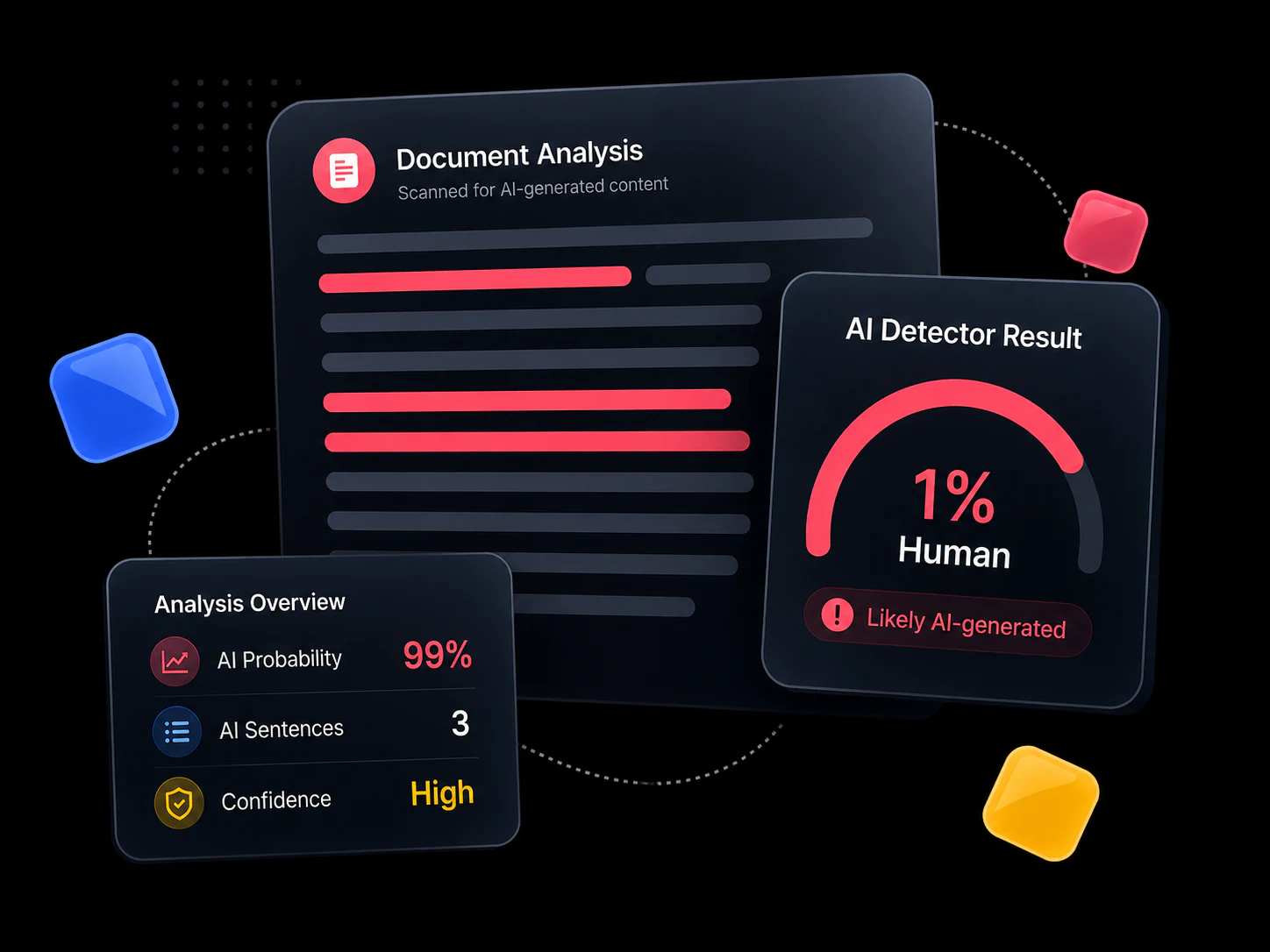
Short answer: detectors can estimate whether writing looks machine-generated. They cannot prove the text came from ChatGPT, and they cannot name OpenAI after a careful edit. Those are different claims, and mixing them is how people get hurt.
If you landed here looking for a “ChatGPT detector,” keep reading for what the tool can actually do — and what to do with the result.
What people usually mean by the question
Most searchers want one of three things: a teacher checking an essay, a recruiter reading an application, or a writer checking their own draft after using ChatGPT for help. In every case the useful question is “does this sound generated?” not “can you subpoena chatgpt.com?”
Marketing pages that promise “99% ChatGPT detection” skip that distinction. The ChatGPT angle on IA Checker is written for the style question, with the limits in the open.
What detectors actually measure
Detectors look for distributional patterns common in large-model prose: even sentence rhythm, safe transitions, generic abstractions, low idiosyncratic risk. ChatGPT output often shows those patterns. So do careful human editors, tutors and non-native writers aiming for clean English.
A high score means the text resembles generated writing. It does not mean “this session used ChatGPT.” Competing models overlap heavily once a draft is polished. For how to read the number itself, see how to read an AI detection score.
Edited drafts and other models
Light paraphrase, synonym swaps and “humanizer” passes push a document toward the middle of the scale. Hybrid verdicts exist for that reason. Treating every mid-scale result as concealed ChatGPT use punishes revision itself.
The same blur applies across vendors. A raw Claude draft can look different from a terse ChatGPT pass; after editing, the model name in your head is not recoverable from the score. The Claude angle makes the same honesty promise for that search query.
How to use a ChatGPT-oriented check
- Paste enough text. Thin samples are noisy.
- Open sentence-level highlights before you act on the percentage.
- Compare flagged spans to drafts, notes or earlier work from the same writer.
- Ask process questions when the stake is a grade or a hire.
- Do not write “proved ChatGPT use” in a report that only has a score.
For classroom process, start with AI detection in schools and the teacher angle.
Limits to keep next to the score
Detection is not attribution. It weakens on short samples, heavy editing, non-English text and formulaic genres. False positives are common enough that human writing gets flagged without any model involved.
Run the check on the AI detector when you need the signals beside the score — not a vendor name pretending to be evidence.